

The Case for Inefficiency
Why Living Well Resists Optimization

The start of a new year reliably makes me reflect on how I spend my time. Not in a dramatic, new year, new me kind of way, but more as an opportunity to take inventory: what feels nourishing, what feels depleting, what do I keep trying to fix.
I have to resist the cultural chatter that cranks up in January. Optimize your life. Improve your habits. Squeeze more out of every hour. Become the best version of yourself.
For a long time, I was good at that game. I’ve loved goal-setting rituals, spreadsheets, and fresh starts. I followed The Happiness Project logic with enthusiasm. I’ve tracked fitness goals, mapped out professional plans, and still set a Goodreads reading goal every year (partly because I love reading and partly because I am susceptible to the dopamine hit of seeing progress toward my goal).
Living with disability has complicated my relationship with optimization culture in ways that have been unexpectedly clarifying. My body does not always cooperate with efficiency, something true of all bodies, and especially of disabled bodies. Plans fall apart. Pacing matters. Over time, I’ve come to understand this through the lens of crip time, a concept from disability studies that names the nonlinear, unpredictable rhythms of disabled and chronically ill lives, like the frequent waiting for assistance for everyday tasks. Crip time does not bend easily to urgency. It asks for flexibility. It quietly refuses the idea that life can be streamlined if you just try hard enough.
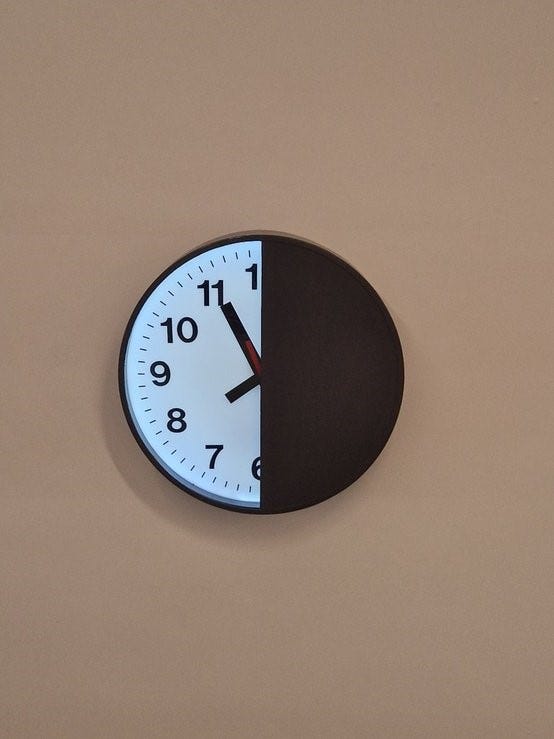
For much of my adult life, my commutes have reflected this. They have rarely been the fastest or most direct option, often a combination of walking, public transit, and relying on rides from others. There has been a lot of waiting: for trains, for rides, for people to arrive. From an efficiency standpoint, every one of those minutes could have been “used” differently. And yet those minutes have held other things. Phone calls catching up with people I love. Moments of mindfulness. Audiobooks I might never have made time for otherwise. Favorite playlists on repeat. I’ve gotten many of my daily steps in this way, often unintentionally. Yes, there were days when trains were delayed or rides fell through, when the friction felt frustrating and exhausting. But over time, I’ve come to see that this forced inefficiency offers me something too, a built-in pause, a transition space, a reminder that moving through the world takes time. Not optimized time. Human time.
I have not arrived at this insight gracefully. Learning to accommodate resistance by accepting the reality that much of life is not optimal has changed how I think about what it means to live well.
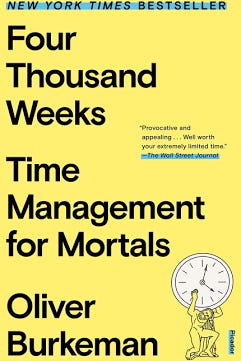
Once you start noticing it, this paradox shows up everywhere. I first read Oliver Burkeman’s Four Thousand Weeks: Time Management for Mortals in late graduate school, and it shook me in the best way. Burkeman suggests that our trouble isn’t simply that time is scarce and therefore needs better management. It’s that time is so limited that no amount of optimization will ever let us experience more than a tiny slice of what life contains. Sitting with that, radically accepting our finitude, something that can sound morbid but I’ve found deeply clarifying, loosens something. The pressure to extract maximum value from every moment softens. Letting go of the fantasy that we can do and have it all turns out to be a relief.
Psychological research backs this up. Colleagues I worked with at Berkeley, Drs. Brett Ford and Iris Mauss, have shown across a number of studies that overvaluing happiness often leads to less of it. When happiness becomes something to pursue, monitor, or optimize, people often report more pressure, disappointment, and dissatisfaction. The effort itself can pull us out of the experiences we hope will make us feel good. Even tracking happiness, especially when comparison and concern creep in, can limit it.
Cassie Mogilner Holmes writes about this tension with striking honesty in Happier Hour. After spending years studying and teaching students how to use time more wisely, she describes rushing her daughter to school one morning and snapping that they didn’t have time to stop and smell the roses. The moment lingered with her because of its irony: knowing what matters doesn’t automatically protect us from the pull of efficiency. Even with insight, it’s easy to move through life as if savoring the moment is a luxury rather than the point.

I see versions of this in the therapy room. A patient introduced her challenges with relaxation, chiding “you’ll love this,” and confessing that she didn’t think she was relaxing “correctly” while doing cross-stitch. What had started as a low-stakes, enjoyable hobby had become layered with self-consciousness. She found herself excitedly thinking about more complex patterns, imagining future skills, and planning her next projects. She became convinced that she was ruining her own relaxation by being invested in the hobby. The ambition itself wasn’t the problem; wanting to improve and engage more deeply was perfectly fine. The tension arose from the fact that, in trying to optimize relaxation by suppressing her ambition, she was no longer truly relaxing. Caring so much about doing it “right” made the activity stressful instead of enjoyable. Trying to relax had become, ironically, another task to optimize. Learning to let loose with the activity took practice and a good dose of patience with herself.
I recognize this tendency in myself. I am embarrassingly susceptible to productivity systems. I’ve lost hours comparing task managers (Trello, Todoist, you name it) convinced that the right tool might finally help me catch up. More than once, I’ve spent longer organizing tasks than it would have taken to complete them. The child in me, who loved school supplies, still delights in color-coded lists and clean interfaces. The adult in me, though, has learned that no system creates more hours. Trying to manufacture time becomes just another task. Finding a good enough system is enough.
There are places in my life where I could absolutely optimize, and choose not to without regret.
My daughter’s daycare is a relatively short drive away, in an area with terrible public transit. From a pure efficiency standpoint, it makes perfect sense that my husband handles drop-off and pick-up. I could opt out and reclaim the time. And some days, especially draining and busy ones, the appeal is real.
But if I did, I’d miss things I can’t quantify: the way her whole being lights up when she sees us at the end of the day; the teacher’s updates about the tea party she planned for her friends, how she reacted to cottage cheese for the first time, or why her dress was on backward (because she put it on herself, of course). The songs we sing in the car, both the real ones and the ones she makes up on the spot. The half-formed stories she tells as she’s still processing the day.
None of this is efficient. None of it moves me closer to publishing my next paper or running my next half marathon. But opting out would cost me something I wouldn’t get back. Saving time, it turns out, comes at a cost.
My goals have had to change shape. Many of the things I want most, being more present with the people I love and slowing down enough to savor ordinary moments, resist measurement. Last year, I set the intention to socialize more with friends, and my partner and I started hosting a monthly brunch. The plan was intentionally loose: anyone could come, with whoever they wanted, for however long they were able. Some months one person showed up briefly; other months the house was full with children, conversation, coffee refills, and friends new and old. Some months plans shifted because of travel, illness, or hospital stays. What mattered wasn’t consistency for its own sake, but creating something flexible enough to meet real life where it was.
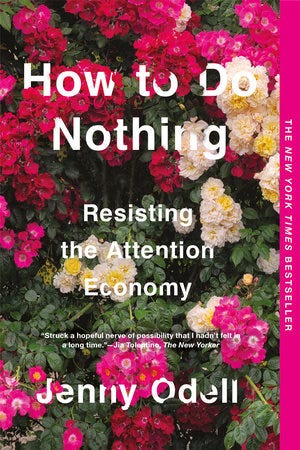
Jenny Odell writes in How to Do Nothing: Resisting the Attention Economy about reclaiming attention from systems that treat time only as something to be spent efficiently. Her work resonates with how I’ve come to understand disability: as a reminder that value exists beyond productivity, that presence and savoring are not indulgences but forms of resistance. Disability has required me to learn this lesson earlier and more often than I might have otherwise. When optimization fails, when the body refuses, when energy runs out, something else becomes possible if we’re willing to listen.
This shows up in unglamorous ways. Because I can’t see most content on my phone and audio and dictation aren’t reliably accessible (background noise, uncharged headphones, competing demands), there are moments when I don’t fill waiting time the way most people do. I’m not scrolling, not reading, not multitasking. I’m just sitting. Waiting. Letting my mind wander. In a culture that treats empty time as a problem to solve, this can feel almost transgressive. And yet, it is often unexpectedly peaceful.
Sometimes doing nothing is doing something.
This has been visceral in our mornings with a toddler. When we’re rushed and trying to optimize the routine: wake up, get dressed, brush teeth, eat, out the door, everything backfires. Meltdowns emerge at every step. Milk (or Mama’s coffee) spills. A bowl of fruit gets launched. We all leave frazzled. When we instead build in extra time for snuggles, tickles, brushing the toy seahorse’s teeth in addition to her own, and all the layers of inefficiency, we are calmer and more connected. Somehow, we are also more functional. Does it eat into my sleep? Absolutely. Does it bring us closer, and often prevent the very chaos I was trying to avoid? Also yes. With a toddler, I’ve learned, efficiency is often the slowest route to peace.
The paradox I keep circling back to is that living a good life seems to require, at some point, loosening our grip on trying to engineer one. The opposite of control is not chaos, it’s trust. Trust that meaning can’t be optimized into existence. Trust that some of what matters most emerges only when we stop tracking, measuring, and upgrading, and allow ourselves to linger (maybe even long enough to smell the roses).