

Resilience Requires Resources
The Hidden Supports Behind What We Call Strength

Resilience is often framed as though it is embedded entirely inside us, as if grit, coping skills, and toughness are all we need. I’m learning that real resilience is messier than that. It’s as much about the cards we’re dealt as how well we play them, and about the people, tools, and systems that can stack the deck in our favor. Sometimes it looks like powering through. Sometimes it looks like learning and mastering the rules of a game we never wanted to play. And more often than not, it’s all of this at once.
And before I dive in, a personal heads-up: my baby is due next week. So if I vanish for a while, that’s why. Expect more reflections, stories filled with chaos, and the usual rambling in the weeks and months to come.
I’ve been thinking a lot lately about resilience. Not the inspirational-quote, grin-and-bear-it version, but the clinical and empirical one. I’ve recently worked on two research papers, one empirical, one commentary, that circle the same question: What do we actually mean when we call someone resilient?
Endurance is part of it, of course. But resilience also involves emotional wellbeing, personal meaning, and coping with adversity. It includes the capacity to experience the full spectrum of emotions: happiness and sadness, gratitude and anger, excitement and fear. Resilience is not relentless optimism, and it is not forced gratitude. It is meeting the moment fully and honestly, with the breadth of human feeling intact. Tenacity, humor, connection, meaning, and hope can coexist with pain, exhaustion, and doubt. These capacities are not superpowers. They can, however, be cultivated, nurtured, and strengthened over time.
Crucially, resilience involves flexibility: the ability to shift strategies as circumstances change. Sometimes we push. Sometimes we rest. Sometimes we problem-solve. Sometimes we grieve. A well-timed joke can diffuse tension; other moments require wading into the weight of what’s happening. Resilience is not a single posture toward adversity; it is the capacity to adjust our posture as needed. From the outside, this can look inconsistent or fragile. Rest can be mistaken for surrender. Refusing to reframe can be read as pessimism. Resilience is layered; it is not persistence with a smile.
A brief warning: this next part gets a bit nerdy. I promise it connects back.
Decades of research, including my own, show that resilience is closely tied to interrelated capacities including emotion regulation, coping, and tendencies towards greater positive emotion. Emotion regulation is how we notice, interpret, express, and modulate our emotional responses. Coping refers to the cognitive and behavioral strategies we use to navigate stress: problem solving, seeking support, distraction, humor, and reframing. Positive emotion, the ability to experience joy, gratitude, and connection, supports wellbeing and buffers against adversity.
Resilience is not simply having these skills for emotion regulation, coping, and cultivating positive emotion; it is knowing which one fits the moment. And while these capacities can be strengthened through practice and support, they are also shaped, and sometimes constrained, by the environments and communities we inhabit.
These capacities are often labeled traits: grit, fortitude, toughness. But they do not emerge in isolation. Emotion regulation develops through repeated experiences of co-regulation and safety, and through lessons, explicit and implicit, about what emotions signify and how to respond. Coping strategies are rehearsed in families, classrooms, therapy offices, faith communities, peer groups, and workplaces. Plus, baseline temperament interacts with these experiences, shaping how we notice, respond to, and recover from stress. Positive emotion, too, thrives in social contexts: it grows through connection, meaningful roles, creative expression, and belonging in communities that reflect our values. Giving support, sharing joy, and contributing to others reinforces our own sense of wellbeing.
Much of what strengthens these capacities is relational and materially supported—safe spaces, accessible resources, mentorship, and time to engage meaningfully. Yet access to these conditions is not evenly distributed, which helps explain why resilience looks different across people, communities, and circumstances.
Across disability, race, gender, immigration status, poverty, and other systems of marginalization, resilience looks different, not because people are fundamentally different, but because the pressures and protections around them vary. When demands are high and resources are scarce, coping requires more effort and flexibility becomes expensive. When resources are plentiful, the same behaviors are labeled strength rather than survival. Marginalized communities are often expected to withstand more while being applauded for doing so. It is a double bind. Admiration can calcify into expectation.
Especially in marginalized communities, resilience rarely resembles a lone individual forging ahead through willpower. It is facilitated when there is stability: reliable healthcare, paid leave, transportation, community networks, safe schools, culturally responsive care, and partners and friends who share the load. It involves space to recover. Sometimes resilience is not about pushing through adversity at all; sometimes it is about having enough backing that pushing is not the only path. Sometimes it means strategically building, advocating for, or demanding environmental affordances rather than silently enduring their absence.
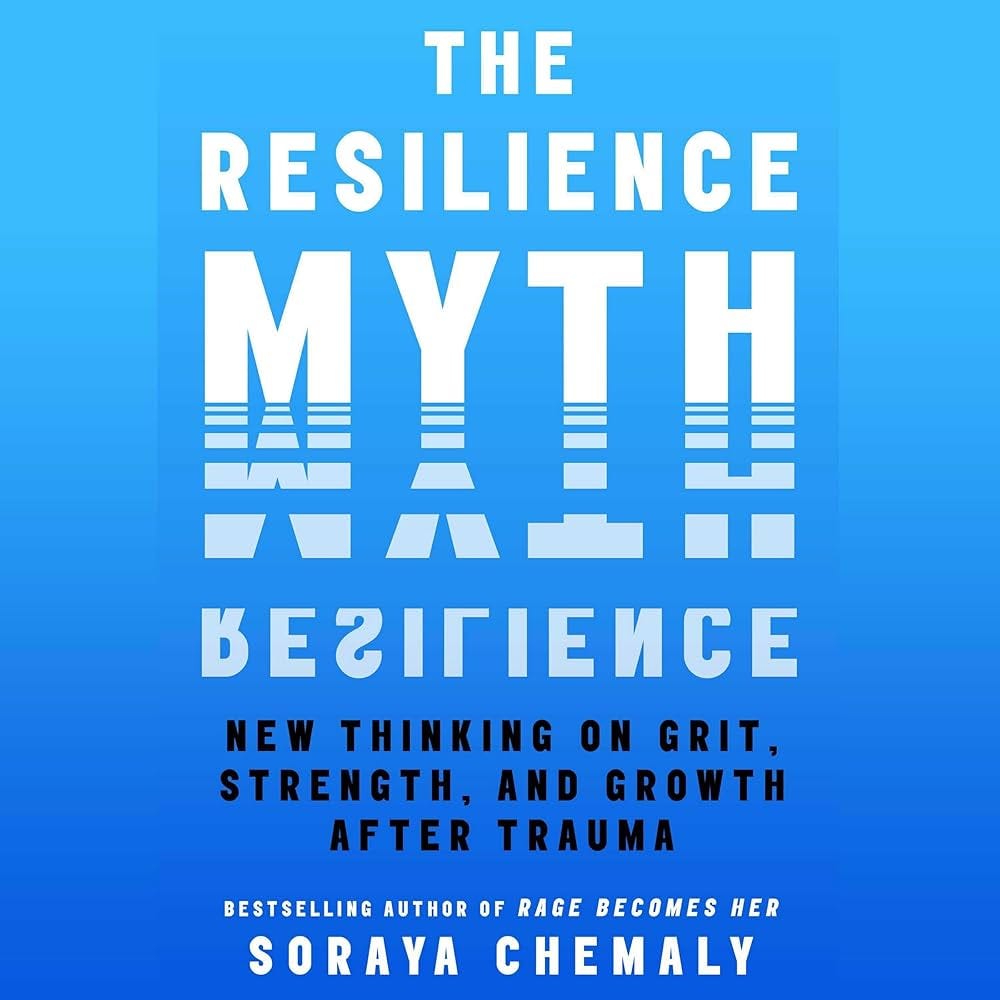
This tension between individual strength and structural reinforcement has been particularly tangible to me as I think about disability. I recently read The Resilience Myth: New Thinking on Grit, Strength, and Growth After Trauma by Soraya Chemaly, which challenges the idea that resilience signals moral virtue. Chemaly questions our attachment to grit and post-traumatic growth, particularly the tidy storyline that suffering inevitably yields wisdom. Embedded in that storyline is an assumption: that hardship is inherently valuable, that adversity polishes character in ways comfort cannot. But pain is not a prerequisite for depth, and difficulty is not a moral credential. Trauma is not automatically transformative. Growth can happen, but it is not assured, and it rarely unfolds without support. When we celebrate resilience without interrogating the conditions that made survival so costly, we risk romanticizing endurance and converting adaptation into a mandate.
Disability makes this pattern apparent. In dominant medical models, disability is framed as an impairment housed within a person, placing the pressure on individuals to adapt, overcome, or compensate. Disability scholarship, by contrast, emphasizes interaction: disability reflects the alignment between bodies and environments. When the environment is accommodating, a disability is less disabling. When it is restrictive, its impact increases. This perspective shifts responsibility from the individual alone to the structures, systems, and communities that can enable participation.
Nearsightedness offers a simple illustration. Without corrective lenses, nearsightedness would limit reading, driving, recognizing faces. In that context, it is a disability. With affordable glasses or contacts, it is easily managed, and often a fashion statement. The visual system remains the same; the surroundings shift its impact.

I recently came across a report ranking U.S. states on how supportive they are for people with disabilities, based on employment, income, healthcare access, transportation, housing, community inclusion. The variation was unmistakable. Some states offer strong legal protections and navigable infrastructure. Others have lower labor force participation, higher poverty rates, fewer transit options, thinner safety nets. This is only within the United States; globally, the gaps widen. The same disability can lead to vastly different trajectories depending on geography. Resilience cannot be evenly distributed when infrastructure is not.
I say this not to toot my own horn but to illustrate with context. I have been called resilient more times than I can count, by patients, mentors, peers, family. Sometimes the comments are blunt or ableist: “I couldn’t live through all you have,” or “I’d die if I lost my sight.” Sometimes they arrive as genuine admiration. I understand the intent. Still, those remarks compress the story.
Yes, I am grateful for the skills that help me navigate hard experiences. Over time, I have learned ways of regulating emotion, solving problems creatively, using humor, reframing when it helps, and sitting with distress without immediately trying to outrun it. These capacities matter. Structural advantage does not erase agency. But agency does not erase where those capacities came from. They did not appear fully formed; they were cultivated.
I grew up in a safe neighborhood and attended a well-resourced public school in an affluent district, where college was treated less as a question than an expectation. Academic enrichment like speech and debate, mock trial, and other extracurricular spaces gave me opportunities to build skills and confidence while connecting me to supportive peers. I benefited not only from institutional resources but also from social privilege: being cisgender, straight, white, and generally healthy meant many doors were already open when I arrived. That does not mean my childhood was uncomplicated; there was significant family adversity. But even within that complexity, stability existed in important places.
By college, those layers of support continued to accumulate. I had encouraging people around me, including a roommate, and lifelong best friend, who read textbooks aloud while I lay on the couch with an eye-strain migraine and a cold washcloth over my face. Not everyone receives a personally curated audiobook powered by generosity and caffeine. I was also on a full scholarship, which meant I was not juggling multiple jobs to afford tuition or housing. My time was not divided between coursework and survival. I had the space to study, to participate fully in classes and friendships, to pursue extracurriculars, even to study abroad. What may have looked like perseverance from the outside was also promoted by privilege. My success was in part individual grit; it was also sustaining infrastructure.
In my twenties, in California, support became even more explicit. Therapy and clinical training provided insight, coping tools, and guidance for using them in everyday life. I learned skills that sounded simple on paper but proved revolutionary in practice: noticing and naming emotions before pushing them away or acting on them impulsively, tolerating and accepting discomfort without immediately trying to escape it, and understanding regulation as something practiced daily rather than something permanently achieved. I also began learning how to make decisions guided more by my values than by social expectations. At the same time, the Department of Rehabilitation offered orientation and mobility training, braille instruction, and assistive technology, all forms of instrumental support that opened access to education and work. Together, these supports helped me navigate both physical space and institutional terrain, buoying me psychologically and materially as I traversed disability, a demanding career path, and adulthood all at once.
Support does not erase the need to adapt; it redistributes its weight. Adaptation still carries a cost. Continually recalibrating to exclusionary systems is cognitively and emotionally taxing. What we often label as resilience often reflects sustained effort more than innate strength. Sometimes resilience involves advocating for change, securing resources, or building systems that reduce unnecessary hardship. And sometimes the most resilient action is not endurance at all, but redirection: saying no, relocating, asking for more help, or refusing to accommodate systems that refuse to accommodate us.
I have lived in California, Washington, and Missouri. The differences in disability resources are unmistakable. They shaped how readily I could access care, find community, navigate bureaucracy, and imagine a future. In California, I connected with disabled peers and professors, joined a blind running group, accessed comprehensive assistive technology, benefited from public transit that was relatively accessible and reliable, and received disability-affirmative healthcare. Those networks and systems enabled participation in ways that have been impossible to reconstruct in Missouri. Same person. Same diagnoses. Different ecosystems.
Much of what we call independence is infrastructure, and infrastructure is relational.
Ableism is not only a structural and systematic shortage of resources for access and inclusion. It is judgment. Stigma. Pity. Assumptions. The belief that something is wrong with you. The questioning of whether you belong in certain rooms. That constant translation, explaining what we need, educating others, clarifying that competence and disability are not opposites, is a cognitive and emotional burden that extends beyond physical access.
I felt this sharply in graduate school when I was assigned my first teaching assistantship. I was afraid. How would I track raised hands? Grade assignments? Notice side conversations? Gauge the engagement in the room? Beneath those logistics sat a deeper worry: Would students take me seriously? Would I maintain authority? Would they respect me if I did things differently?
I had the privilege of connecting with a blind professor known for exceptional teaching. She offered concrete strategies and reframed the premise. Authority does not hinge on eyesight. Structure does not require surveillance. She normalized the fear. She laughed with me about the absurd moments. The shame that felt like inadequacy became a target for troubleshooting.
That was not inherent resilience. It was resilience scaffolded through mentorship, modeling, humor, and belonging.
As a researcher, I can say those dimensions are difficult to capture. It is easier to measure self-reported coping than to gauge whether someone moves through the world braced for bias. Yet those currents shape flexibility as much as any internal quality.
I feel this tension in my clinical work too. As a psychologist, I am trained to ask: What can we cultivate within the individual? What practices might ease distress? That focus has value. Coping skills, relaxation techniques, mindfulness, reframing, and behavioral activation help. They are evidence-based tools, grounded in well-validated therapy approaches.
But people do not live in isolation. Coping skills widen response options, but they cannot on their own dismantle stigma, fix inaccessible transit, ensure affordable housing and healthcare, or transform inequitable systems. Liberation psychology reminds us that distress is shaped by oppression, and restorative approaches emphasize the relational, collective dimensions of repair. Resilience is not just an individual project; it is a dialogue between the person and their environment.
Resilience is dynamic and reciprocal. It arises from the interplay between personal capacities and environmental affordances. It is shaped by policy, geography, money, training, and relationships. In practice, true resilience combines personal capacities with relational and structural supports; it is as much about leveraging, creating, and demanding affordances as it is about enduring adversity.
We are capable of strength. But we should not have to rely on extraordinary strength simply to participate in ordinary life. Perhaps the most powerful form of resilience is not relentless endurance, but the freedom that is fostered by people, policies, and systems to respond to hardship in more ways.